
When Your Neck Ages Faster Than Your Face: Facelift and Neck Lift Options
THE FACIAL REJUVENATION JOURNAL | CHARLESTON & MOUNT PLEASANT
You feel like yourself. You have plans, energy, and plenty of reasons to smile. But in photographs, the line between your chin and neck seems less defined than you remember. Perhaps you have started choosing higher necklines or lifting the skin beside your jaw when you look in the mirror.
It is not necessarily your entire face that concerns you. Sometimes it is simply the neck—or the way the lower face and neck no longer seem to belong to the same picture.
This is an illustrative scenario, not an individual patient testimonial. It reflects a question many people bring to facial rejuvenation consultations: “Do I need a facelift, a neck lift, or both?”
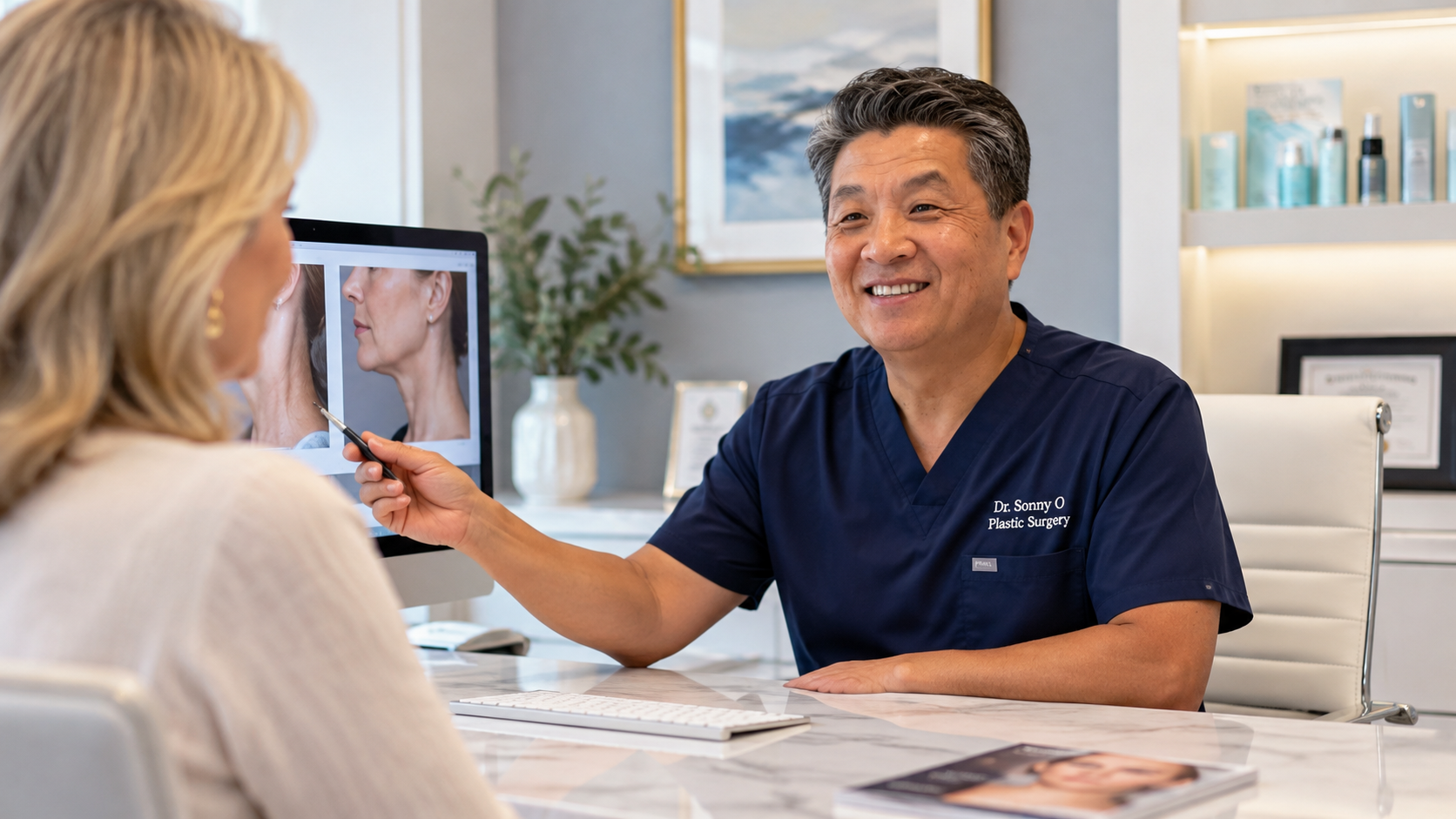
At Dr. Sonny O Plastic Surgery & MedSpa in Mount Pleasant, serving Charleston and the Lowcountry, the answer begins with your anatomy and your goals—not a one-size-fits-all procedure.
The guiding idea: A natural-looking result comes from understanding how the cheeks, jowls, jawline, and neck work together. The most appropriate procedure may treat one area or several, depending on what has changed.
Why the neck can seem to age before the rest of the face
Facial aging does not happen evenly. The skin gradually changes in elasticity and texture; fat distribution and deeper support tissues change as well. In the lower face, tissue descent can create jowls that soften the jawline. Beneath the chin, fullness, loose skin, or separation and banding of the platysma muscle may contribute to a less defined neck.
These concerns can look similar in a photograph but require different treatment. A person with relatively firm skin and localized fullness may have a different plan from someone with prominent jowls, vertical neck bands, and excess skin. That is why a thoughtful examination matters more than choosing a procedure from a photograph.
Why Dr. O treats the lower face and neck as one aesthetic unit
Facelift: restoring lower-face support
A facelift addresses age-related changes in the face, particularly the cheeks, jowls, and jawline. Depending on the technique, the surgeon repositions deeper supporting tissues and redrapes the skin rather than relying on skin tightening alone.
Neck rejuvenation: maintaining harmony with the lower face
Neck rejuvenation may address loose neck skin, platysma bands, and selected fullness beneath the chin. However, Dr. O does not perform an isolated neck lift: when the neck requires surgical correction, he also incorporates appropriate lower-face lifting. The lower face, jawline, and neck are evaluated as a connected aesthetic unit so that improvement beneath the chin transitions naturally into the face. Depending on anatomy, the surgical plan may include repositioning deeper tissues, addressing the platysma, and carefully redraping skin.
Dr. O’s philosophy: The lower face and neck form one aesthetic unit. A facelift can be tailored to the lower face without extensive neck correction when appropriate. But when the neck needs surgical rejuvenation, Dr. O also lifts the lower face to create a harmonious transition from the cheeks through the jawline into the neck. The precise extent of surgery is personalized to each patient.
What happens during lower-face and neck rejuvenation?
Dr. O will explain the approach recommended for you. In general, surgery may involve the following stages:
1. Planning the incisions
Incisions for facelift and neck procedures commonly follow contours around the ears and may extend into the hairline. A small incision beneath the chin may be recommended when direct treatment of neck muscles or fat is needed. The location and length depend on the extent of correction and your anatomy. Every incision leaves a scar, although placement is designed to make it less conspicuous.
2. Repositioning deeper tissues
Facelift techniques address the deeper facial support system in different ways. In a deep plane facelift, selected tissue attachments are released so the deeper tissues can be mobilized and repositioned. Other facelift techniques adjust the SMAS layer differently. A neck lift may also involve tightening or repositioning the platysma muscle and addressing selected fullness under the chin.
3. Redraping the skin and closing the incisions
Once the supporting tissues are addressed, the skin is redraped and any appropriate excess is removed. The incisions are then closed. The goal is improved definition with an appearance that respects your natural features—not a stretched or overly tight look.
Some patients benefit from a more limited approach; others need a broader plan. Dr. O’s Timeless Lift™ encompasses individualized facelift options, including procedures offered under local anesthesia when appropriate.
Can combined lower-face and neck rejuvenation be performed under local anesthesia?
Dr. O offers local-anesthesia facial surgery for appropriately selected patients. Local anesthetic numbs the operative area, while sedation—if used—is a separate part of the anesthesia plan. The suitability of local anesthesia depends on the scope of surgery, medical history, comfort needs, and the care team’s assessment. A combined face-and-neck procedure may require a different approach than a limited procedure.
Local anesthesia does not eliminate surgical or medication-related risks. During your consultation, ask what type of anesthesia is recommended, whether sedation is expected, who will monitor you, and what care will be needed afterward.
What will recovery look like?
Expect swelling, bruising, tightness, and some temporary changes in sensation. Dressings may be used, and some patients require drains. You will receive instructions for incision care, medications, sleeping position, activity restrictions, and follow-up appointments. Arrange transportation and help at home according to your surgical team’s directions.
Many people need at least one to two weeks before feeling comfortable with some social activities after facelift surgery, but this is not a guaranteed timeline. Swelling and changes in sensation can take weeks or months to settle, particularly after more extensive treatment. If you have an important event, plan extra time and ask for an individualized recovery estimate.
For additional patient education, see the American Society of Plastic Surgeons’ neck lift procedure guide and recovery guidance.
Real results begin with realistic expectations
A facelift or neck lift can improve contours, but neither procedure stops aging, guarantees symmetry, or corrects every surface wrinkle. Surgery also carries risks, including bleeding or hematoma, infection, poor wound healing, changes in sensation, nerve injury, asymmetry, unfavorable scarring, and possible need for revision. Your medical history and treatment plan affect those risks.

What should you ask at your consultation?
- Are my concerns coming primarily from jowls, loose neck skin, muscle banding, or fullness beneath the chin?
- Would a facelift focused on the lower face be sufficient, or would lower-face lifting with neck rejuvenation provide a more balanced result?
- Where would my incisions be placed, and what scars should I expect?
- Would a deep plane technique be appropriate for my anatomy?
- Am I a candidate for local anesthesia, and would sedation be involved?
- What are my individual surgical risks and expected recovery needs?
- Can I review before-and-after results from patients with concerns similar to mine?
Frequently asked questions
Does Dr. O perform a neck lift without a facelift?
No. Dr. O evaluates the lower face and neck together and incorporates appropriate lower-face lifting when surgically rejuvenating the neck. This helps avoid an abrupt contrast between the jawline and neck. A facelift, however, can be performed without extensive neck correction when the neck does not require it.
Does a deep plane facelift automatically include a neck lift?
No. The term describes a facelift technique, not a universal list of included procedures. Ask which face and neck steps are specifically included in your surgical plan.
Can nonsurgical treatments replace a neck lift?
Nonsurgical treatments may improve selected concerns such as skin texture or mild laxity, but they generally cannot reproduce the correction of substantial loose skin or muscle banding achieved with surgery. Your options depend on the underlying cause.
How long will my results last?
Results can be long-lasting, but aging continues. Longevity varies with anatomy, skin quality, lifestyle, and the procedure performed. Sun protection and healthy habits support long-term skin health.
YOUR NEXT STEP
A more defined jawline. A plan that still feels like you.
Ready to map out your aesthetic journey? Reserve a personalized evaluation with Dr. Sonny O to understand the changes you see and the surgical options that may address them.
Dedicated Time: A private, comprehensive conversation centered on your goals.
Expert Analysis: A careful evaluation of facial and neck anatomy, tissue support, and aging patterns.
Consultation Fee: A $100 investment to reserve your specialized appointment.
Personalized Roadmap: Clear recommendations, alternatives, and a discussion of recovery and risks.
Reserve Your Personalized Consultation
Still exploring? Take the Facelift Qualification Quiz.
Educational content only. Surgical candidacy, anesthesia, results, and recovery vary. A personal consultation is required to discuss your options and risks.

